
Sleevenotes from PFCD282, The Marshes of Glynn and Song of the Prairies – compositions by Andrew Downes.
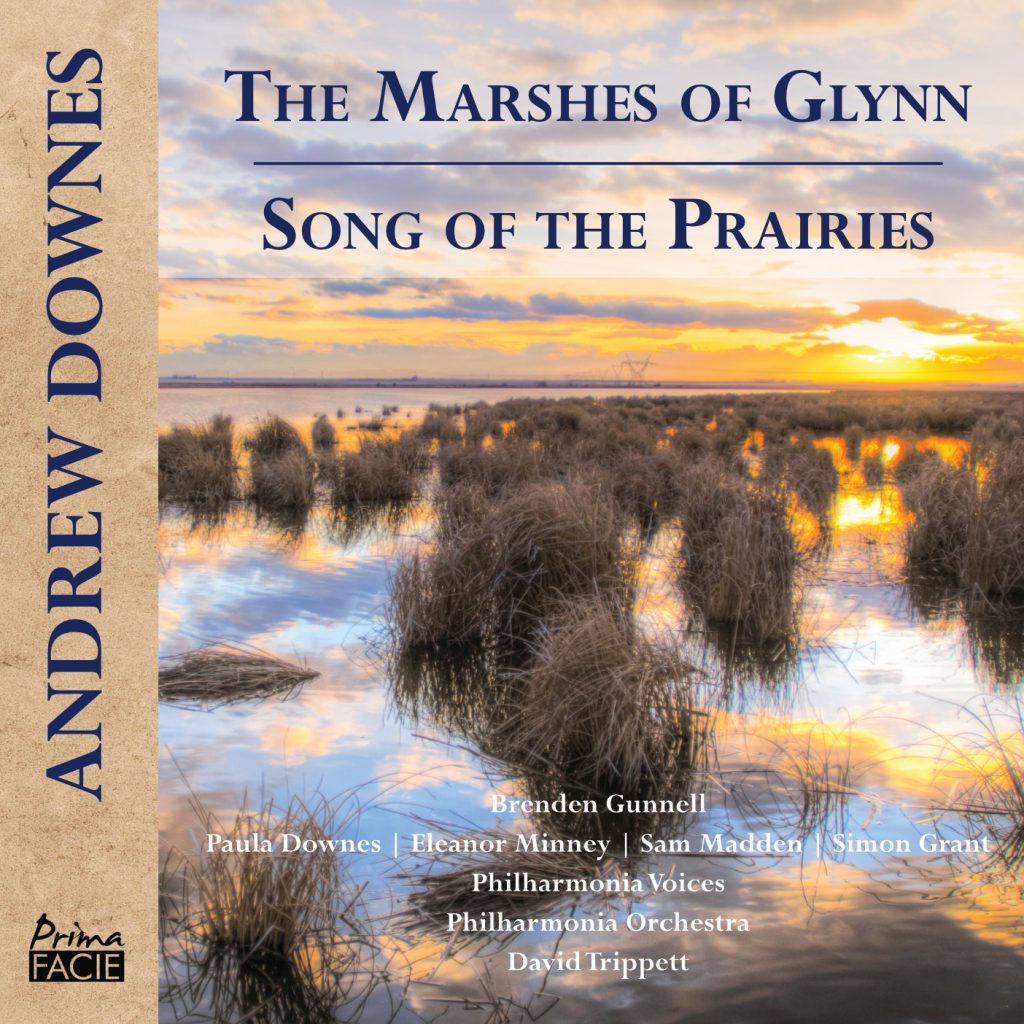
The Marshes of Glynn
Song of the Prairies
The Marshes of Glynn, Op. 33 (1985)
Cantata for tenor solo, SATB choir and symphony orchestra
- Very slow [13:35]
- Allegro [06:15]
- Very slow, once again [09:29]
Song of the Prairies, Op. 44 (1988)
Cantata for SATB soloists, semi-choir of high voices, full chorus and symphony orchestra
- Allegro ma non troppo [06:38]
- Andante [11:03]
- Moderato [04:02]
- Moderato [06:55]
Brenden Gunnell tenor
Paula Downes soprano
Eleanor Minney mezzo soprano
Sam Madden tenor
Simon Grant bass
Philharmonia Voices
Philharmonia Orchestra
David Trippett conductor
Undulations of Time and Tide:
Two Poetic Visions of American Nature
“For a transitory enchanted moment man must have held his breath in the presence of this continent, compelled into an aesthetic contemplation he neither understood nor desired, face to face for the last time in history with something commensurate to his capacity for wonder.” In these lines from the end of The Great Gatsby, F. Scott Fitzgerald imagined Europeans being awestruck by their first encounter with the land they called the New World. The image, however, owes less to early seafarers’ accounts than to nineteenth-century poems like William Cullen Bryant’s ‘The Prairies’ (1833) and Sidney Lanier’s ‘The Marshes of Glynn’ (1878).
Bryant’s and Lanier’s poems bookend a glorious burgeoning of nature-writing in the USA in which poets responded with sensitivity and awe to the beauty and vastness of the North American continent, rather than treating the land as mere commodity or agricultural resource. Bryant’s friend, the novelist James Fenimore Cooper, transplanted European historical romance into the forests and prairies, and, from his lakeside retreat in New England, Henry David Thoreau declared that what was needed in an era of rapid urbanisation was ‘the tonic of wildness’. Many tourists, including Transcendentalist writer Margaret Fuller, travelled the new railroad to Niagara Falls and took a steamer to the Midwest to witness the ‘mushroom growth’ of rapid Westward expansion. But, after the cataclysm of the US Civil War in the 1860s, the poet and musician, Sidney Lanier, sought a different kind of tonic in the Southern coastal marshes. Having caught tuberculosis as a POW in a Union gaol, Lanier travelled the South for his health, and his hymn to the spreading live oaks and to the liminal zone where earth and water meet, show the landscape lifting him above all earthly troubles.
Celebrating the beauty of the American landscape was an act of literary nationalism for these American authors, who were rebuffing Sydney Smith’s sneering question in The Edinburgh Review in 1820, ‘Who reads an American book?’. In 1841, turning the issue of cultural capital on its head, Ralph Waldo Emerson argued that American ‘self-reliance’ required writers ‘to set at naught books and traditions’, and to intuit the divine instead through direct communion with nature. Emily Dickinson needed only ‘one clover and one bee’ to create her own inner prairie, but Bryant and Lanier wrote rangier poems that evoked the inspirational breadth of savanna and marsh, allowing these American landscapes to enter and stretch the forms of English verse. Bryant’s blank verse poem, is the more conventional in style, though it uses enjambment to great effect: the opening descriptions overspill the line-endings and pause midline, creating ‘airy undulations’ within the regular pentameter form. Lanier’s more unruly poem was written later in the century, after the verse form experiments of Walt Whitman’s Leaves of Grass and Henry Wadsworth Longfellow’s Hiawatha and Evangeline. Though it has rhythm and rhyme, Lanier’s poem follows no set pattern but is shaped to the dynamics of the poet’s inner experience.
As was conventional in English Romantic poetry, both poems describe a solitary experience, and yet both conjure a larger community and thereby invite a choral interpretation. Bryant’s paean to the ‘unshorn fields’ prophesies ‘the rustling of the heavy grain’ as the plains fill with well-behaved homesteaders. Following the lead of the honey-bees, the emblem of a hard-working colony, the settlers will make the supposedly empty land resound with the harmonious lowing of cattle and singing of ‘sweet’ hymns. In Bryant’s Providential vision, the beauty of the land is inseparable from its potential as a pastoral utopia. The buzzing prairie ‘quick with life’ mutates easily into a village idyll similar to that celebrated in the eighteenth-century verse that Bryant admired, including Gray’s ‘Elegy in a Country Churchyard’.
Yet there’s a menacing drama within Bryant’s vision: ‘dark hollows’ chase the ‘sunny ridges’ as clouds pass overhead and this flickering play of time and motion foreshadows the rise and fall of civilisations that Bryant reads into the landscape in the second part of the poem. Influenced by prevailing archaeological theories, Bryant interpreted the manmade earthworks that were scattered across the prairie as the remnants of a civilisation that had been ‘butchered’, like Greece and Rome, by barbarian hordes. According to the mound-builder myth, the descendants of those uncivilised attackers were the ‘Indians’ whose ‘Removal’ was being violently enacted by the US government in the 1830s. The archaeological story provided moral justification for the removal of Indigenous inhabitants so that settlers could ‘restore’ civilisation to the prairies.
The triumphalism of Bryant’s vision, however, is undercut by the gape of deep time. The dream of a rising civilisation is part of a larger pattern: the ‘majestic’ bison whose herds in the West still ‘shake/ The earth with thundering steps’ are, on the Eastern prairie, remembered in silent ‘footprints’. Shortly after Bryant wrote ‘The Prairies’, following a visit to his brother who was a settler in Illinois, Bryant’s friend Thomas Cole began painting The Course of Empire (1833-36). These five paintings portray an imaginary civilisation from formation, through prosperity, to cataclysmic destruction. The prairies, in Bryant’s poem, are a palimpsest of past, present and future, with inhabitants overlaid like notes in a chord, or projections in a magic lantern show, as his mixed possessives (‘their’, ‘his’, ‘my’) show: ‘The prairie-wolf / Hunts in their meadows, and his fresh-dug den / Yawns by my path.’
Where Bryant heard the whispers of history in the prairies, Lanier found escape from the human in the marshes. He describes the solace of feeling freed from ‘the scythe of time, and the trowel of trade’, and finding all fear and conflict resolved in an experience of amplitude. ‘We need to witness our own limits transgressed’ Thoreau counselled, and Lanier’s poem gives a poetic form to that exhilaration. Although spoken by a lone traveller, the poem flows in many directions, not holding to one line of thought, or indeed to one length of line, but ‘swerving’ and ‘curving’ to celebrate the expansive freedom that Lanier found in the marshes and ‘the greatness of God’. Expressive apostrophes: ‘O braided dusks’, ‘Affable live oak’, ‘Ye marshes’ give personality to the surrounding natural features, so that the poet’s words disperse into them like the roots and rivulets he describes. Besides writing poetry, Lanier worked as a professional musician and he wrote a book on the parallels between poetry and music. Like the poems of Edgar Allan Poe, one of his Southern literary predecessors, Lanier’s poetry is lush with repeated and interwoven sounds: ‘the sand-beach fastens the fringe of the marsh to the folds of the land’, ‘And the marsh is meshed with a million veins’. Words melt and morph into each other, rhymes arrive in the middle of lines, and the verse pulses with alliterative patterns that recall Medieval English verse.
Like many nineteenth-century Southern writers, Lanier was inspired by tales of chivalry, and his publications include Arthurian tales for children. His gives his figure, facing the marsh and the sea, a heroic grandeur as a man ‘who hath mightily won/ God out of knowledge and good out of infinite pain.’ The poem’s archaic language (‘hath’, ‘twixt, ‘passeth’) makes the poem sound like a new psalm, written for the King James Bible from the marshes of Georgia. Where Bryant was nationalistic and slightly haunted in his vision for the prairies, Lanier threw caution to the winds in his fulsome expression of ecstasy and communion with nature. But he commits, in terms of ideas, to nothing specific. His imagery is politically ambidextrous: ‘live oaks’ were a symbol of Southern identity, but seeking freedom in swamps and marshes had been the action of runaway slaves. The poem’s blend of mystical hope, tinged with a weary melancholy, voices a certain postwar Southern mood, and the rapturous vision of oneness in which all division is obliterated by the tide encodes more history and politics than at first meets the eye.
Amy M. E. Morris
Evoking Landscapes in Sound
The Marshes of Glynn (1985)
The nineteenth-century American poet Sidney Lanier liked to use dactyls, metrical units in which an emphatic first beat is followed by two, less emphasized, pitter-pattering syllables. This approach to rhythm is more typical of Ancient Greek and Roman epics than of English verse. It gives his texts a potent, marching quality that is both mesmerizing and slightly disquieting, given his background as a confederate soldier in the American Civil War. Lanier built a career as a professional flutist, and his poetry exhibits a distinctive musicality: he methodically repeats words and short phrases as a composer might do when developing a melodic idea, and his dactyls fit cleanly into the duple meters that dominate the Western canon. It was likely these qualities that appealed to the British composer Andrew Downes when his father-in-law introduced him to The Marshes of Glynn, Lanier’s 1877 ode to the green expanse found where the coast of Georgia meets the Atlantic Ocean. Downes was preparing a cantata to mark the 1986 opening of the Adrian Boult Concert Hall at the Birmingham School of Music, and Lanier’s substantial text served as a rich source of inspiration for this work, his first major composition for voices and orchestra.
The trilogy of environments found in the poem become the setting for the three movements of the cantata. We begin in a thick forest of entangled Southern oak trees. Downes evokes the quiet isolation of the shade—the “wildwood privacies” of “beautiful glooms” to use Lanier’s words—with a pastoral theme featuring descending intervals in the French horns that project a serene, silvan majesty. The eerie ding of a glockenspiel suggests beams of light that poke through the cover of the oaks at sunset, and the movement ends with a bright, orchestral climax as the speaker pushes boughs of the trees out of the way to exit to a nearby beach. The snaking, sparkling flute at the start of the second movement depicts that serpentine stretch of gray sand, the thin tissue that connects the sea and the marsh to the land. In the third movement, which lands us in the midst of the marsh itself, the humble croak of the marsh-hen can be heard in solos for English horn, while undulating string and choral interludes show the tide gradually flowing into the grassland until “the sea and the marsh are one.”
Composers often translate dactyls like those in Lanier’s poem into assertive sequences of long-short-short rhythms, which can lend music a driven, marching quality. Downes instead sets most of the text in bands of flowing triplets, which soften the vaguely militaristic pounding of the text. These labile musical figures help to bring out the twisting imagery that unifies disparate parts of the poem. The oaks are “beautiful-braided and woven” with vines that “Clamber the forks of the multiform boughs,” and at the start of the first movement, Downes has the high voices form a braid of subtly modulating triplet gestures. When the “beach-lines linger and curl / As a silver-wrought garment that clings to and follows the firm sweet limbs of a girl,” unison voices become a single, descriptive instrument, tracing a winding, monophonic path that imitates the curling contour of the sand. As the tide comes in, little rivulets cut through the marsh, “a million veins” that fill up with water, and Downes stretches his wandering triplet figures out in long melismas. He makes a stunning musical unity from this textual continuity, and then he uses that unity to accentuate the contrasting atmospheres of the waystations on the journey described in the poem.
In one of the most striking passages in this text, Lanier describes how the limbs of trees divide space in the woods, creating “Cells for the passionate pleasure of prayer for the soul that grieves.” In Downes’s setting, the orchestra fades out before this line, and the choir sings it a cappella in solemn four-part harmony. The textural change bisects the musical form, forming a cloistered moment that is marked out from the rest of the structure. Such contrasts become a key organizing principle of the piece, and indeed of all of Downes’s large-scale works for chorus and orchestra, in which he consistently punctuates full-bodied symphonic sections with intimate cells of choral counterpoint, chant, and recitative. Later in the first movement of The Marshes of Glynn, he writes another arresting choral passage, this time in the style of the spirituals sung by enslaved Black Americans. He briefly spirits the listener away from the nostalgic, bucolic mood that characterizes the surface of the text, emphasizing instead the exhaustion and sorrow that is also present. The work ends in a darker place than it begins, with a lullaby in which the singers muse on the menacing forces that sit under “the waters of sleep” and finally with one last a cappella choral passage that comes to rest on a funereal, E-flat-minor chord.
Song of the Prairies (1988)
In the 1960s and 70s, a group of American composers that included Steve Reich and Philip Glass developed a method of composition in which they repeated small rhythmic and melodic grooves at extreme length and changed harmonies very gradually if at all. This approach, which came to be known as “minimalism,” had extensive roots in pop, rock, jazz, as well as the developmental, cyclic rhythms found in music from Northern India and West Africa. These kinds of music from around the world all also had a profound influence on English composer Andrew Downes, and yet he generally produced work that sounds markedly different from the minimalist creations that were globally ascendant by the 1980s. Downes had been a choral scholar at Cambridge and a student of Herbert Howells. As the progeny of the English choral tradition, he may have been too in love with the subtle shading that harmonic change gives to musical works small and large to compose in a manner that intentionally spreads out and flattens tonal drive.
Downes’s 1988 cantata Song of the Prairies, which he wrote for an annual singing weekend at Shrewsbury Public School that would be led by John Rutter, is a rare piece of his that sounds beholden, if not loyal, to minimalism. In it, he does not abandon the harmonically rich choral style he was known for. Rather, he develops an elegant conversation between two kinds of music that on their surfaces are inverses of one another: minimalist pieces tend to be rhythmically active but feature a leisurely harmonic rhythm, while 20th-century English choral works are often rhythmically nebulous but constantly leverage expressive, harmonic twists and turns. The result of this combination is striking and quite unique—as though the Philip Glass Ensemble has stumbled into a Cambridge Evensong and everyone at the service is open to making it work.
Song of the Prairies is a setting of a poem by William Cullen Bryant, which describes the expanse of the American West and the changes that occur to the landscape as first Native Americans and then White colonists spread across it. The composer indicated that the work was “dedicated to the expression of the beauty and power of nature and is at the same time a passionate protest, mingled with nostalgia, at man’s appalling treatment of his natural heritage.” The stunning grandeur of the landscape is captured by the orchestral writing found throughout the score. As Glass does in Koyaanisqatsi, an experimental film from 1982 that features chains of time-lapse images of the earth, Downes expresses the majesty of the plains with percussion grooves and ostinatos, with bounding, repetitive string parts, and with soaring brass lines. The climactic end of the first movement is a buildup in which the same harmony, implied by chiming lines in the crotales, glockenspiel, and marimba, endures for two minutes. Energy accumulates from the increasingly tense and rhythmic layering of voice entries. In the second movement, text describing “ample fields” and roaming herds of bison is sung above an ostinato from the low strings that creates a broad yet static scene. And for much of the finale, Downes uses only two different chords, establishing a soothing, undulating atmosphere.
The vocal writing provides an unsettling force, which reminds us of the threat that human beings represent to these landscapes. As in all of his major vocal-orchestra works, Downes alternates between full scoring and tender a cappella sections, and these vocal passages provide an impassioned corrective to the pastoral nostalgia of the more minimalist-oriented moments. From the very first a cappella entry for the choir, we are faced with uncanny, piercing high Bs from the solo soprano, which hauntingly emphasize the development of a chord progression. In the second movement, Downes rarely lets a groove settle in. Moments of accumulating rhythmic intensity are cut off by choral interludes that develop the narrative at hand, a brutal depiction of cycles of violence on the land. In the last movement, the sopranos again reach that piercing high note, a warning siren creates a visceral sense of urgency as the text speaks of “the sound of that advancing multitude which soon shall fill these deserts.” At the very end of the piece, the voices are carefully replaced by the pure, bright sound of two trumpets, which create a fragile partnership between the music of humans and the awe-inspiring, monumental sounds of the prairie.
Nicky Swett
Texts
The Marshes of Glynn
Sidney Lanier (1842-1881)
l
Glooms of the live-oaks, beautiful-braided and woven
With intricate shades of the vines that myriad-cloven
Clamber the forks of the multiform boughs,–
Emerald twilights,–
Virginal shy lights,
Wrought of the leaves to allure to the whisper of vows,
When lovers pace timidly down through the green colonnades
Of the dim sweet woods, of the dear dark woods,
Of the heavenly woods and glades,
That run to the radiant marginal sand-beach within
The wide sea-marshes of Glynn;–
Beautiful glooms, soft dusks in the noon-day fire,–
Wildwood privacies, closets of lone desire,
Chamber from chamber parted with wavering arras of leaves,–
Cells for the passionate pleasure of prayer to the soul that grieves,
Pure with a sense of the passing of saints through the wood,
Cool for the dutiful weighing of ill with good;–
O braided dusks of the oak and woven shades of the vine,
While the riotous noon-day sun of the June-day long did shine
Ye held me fast in your heart and I held you fast in mine;
But now when the noon is no more, and riot is rest,
And the sun is a-wait at the ponderous gate of the West,
And the slant yellow beam down the wood-aisle doth seem
Like a lane into heaven that leads from a dream,–
Ay, now, when my soul all day hath drunken the soul of the oak,
And my heart is at ease from men, and the wearisome sound of the stroke
Of the scythe of time and the trowel of trade is low,
And belief overmasters doubt, and I know that I know,
And my spirit is grown to a lordly great compass within,
That the length and the breadth and the sweep of the marshes of Glynn
Will work me no fear like the fear they have wrought me of yore
When length was fatigue, and when breadth was but bitterness sore,
And when terror and shrinking and dreary unnamable pain
Drew over me out of the merciless miles of the plain,–
Oh, now, unafraid, I am fain to face
The vast sweet visage of space.
To the edge of the wood I am drawn, I am drawn,
Where the gray beach glimmering runs, as a belt of the dawn,
For a mete and a mark
To the forest-dark:–
So:
Affable live-oak, leaning low,–
Thus–with your favor–soft, with a reverent hand,
(Not lightly touching your person, Lord of the land!)
Bending your beauty aside, with a step I stand
On the firm-packed sand,
Free
By a world of marsh that borders a world of sea.
ll
Sinuous southward and sinuous northward the shimmering band
Of the sand-beach fastens the fringe of the marsh to the folds of the land.
Inward and outward to northward and southward the beach-lines linger and curl
As a silver-wrought garment that clings to and follows
the firm sweet limbs of a girl.
Vanishing, swerving, evermore curving again into sight,
Softly the sand-beach wavers away to a dim gray looping of light.
And what if behind me to westward the wall of the woods stands high?
The world lies east: how ample, the marsh and the sea and the sky!
A league and a league of marsh-grass, waist-high, broad in the blade,
Green, and all of a height, and unflecked with a light or a shade,
Stretch leisurely off, in a pleasant plain,
To the terminal blue of the main.
Oh, what is abroad in the marsh and the terminal sea?
Somehow my soul seems suddenly free
From the weighing of fate and the sad discussion of sin,
By the length and the breadth and the sweep of the marshes of Glynn.
Ye marshes, how candid and simple and nothing-withholding and free
Ye publish yourselves to the sky and offer yourselves to the sea!
Tolerant plains, that suffer the sea and the rains and the sun,
Ye spread and span like the catholic man who hath mightily won
God out of knowledge and good out of infinite pain
And sight out of blindness and purity out of a stain.
lll
As the marsh-hen secretly builds on the watery sod,
Behold I will build me a nest on the greatness of God:
I will fly in the greatness of God as the marsh-hen flies
In the freedom that fills all the space ‘twixt the marsh and the skies:
By so many roots as the marsh-grass sends in the sod
I will heartily lay me a-hold on the greatness of God:
Oh, like to the greatness of God is the greatness within
The range of the marshes, the liberal marshes of Glynn.
And the sea lends large, as the marsh: lo, out of his plenty the sea
Pours fast: full soon the time of the flood-tide must be:
Look how the grace of the sea doth go
About and about through the intricate channels that flow
Here and there,
Everywhere,
Till his waters have flooded the uttermost creeks and the low-lying lanes,
And the marsh is meshed with a million veins,
That like as with rosy and silvery essences flow
In the rose-and-silver evening glow.
Farewell, my lord Sun!
The creeks overflow: a thousand rivulets run
‘Twixt the roots of the sod; the blades of the marsh-grass stir;
Passeth a hurrying sound of wings that westward whirr;
Passeth, and all is still; and the currents cease to run;
And the sea and the marsh are one.
How still the plains of the waters be!
The tide is in his ecstasy.
The tide is at his highest height:
And it is night.
And now from the Vast of the Lord will the waters of sleep
Roll in on the souls of men,
But who will reveal to our waking ken
The forms that swim and the shapes that creep
Under the waters of sleep?
And I would I could know what swimmeth below when the tide comes in
On the length and the breadth of the marvellous marshes of Glynn.
The Prairies
William Cullen Bryant (1794-1878)
l
These are the gardens of the Desert, these
The unshorn fields, boundless and beautiful,
For which the speech of England has no name—
The Prairies. I behold them for the first,
And my heart swells, while the dilated sight
Takes in the encircling vastness. Lo! they stretch,
In airy undulations, far away,
As if the ocean, in his gentlest swell,
Stood still, with all his rounded billows fixed,
And motionless forever. —Motionless?—
No—they are all unchained again. The clouds
Sweep over with their shadows, and, beneath,
The surface rolls and fluctuates to the eye;
Dark hollows seem to glide along and chase
The sunny ridges. Breezes of the South!
Who toss the golden and the flame-like flowers,
And pass the prairie-hawk that, poised on high,
Flaps his broad wings, yet moves not—ye have played
Among the palms of Mexico and vines
Of Texas, and have crisped the limpid brooks
That from the fountains of Sonora glide
Into the calm Pacific—have ye fanned
A nobler or a lovelier scene than this?
Man hath no power in all this glorious work:
The hand that built the firmament hath heaved
And smoothed these verdant swells, and sown their slopes
With herbage, planted them with island groves,
And hedged them round with forests. Fitting floor
For this magnificent temple of the sky—
With flowers whose glory and whose multitude
Rival the constellations! The great heavens
Seem to stoop down upon the scene in love,—
A nearer vault, and of a tenderer blue,
Than that which bends above our eastern hills.
ll
As o’er the verdant waste I guide my steed,
Among the high rank grass that sweeps his sides
The hollow beating of his footsteps seems
A sacrilegious sound. I think of those
Upon whose rest he tramples. Are they here—
The dead of other days?—and did the dust
Of these fair solitudes once stir with life
And burn with passion? Let the mighty mounds
That overlook the rivers, or that rise
In the dim forest crowded with old oaks,
Answer. A race, that long has passed away,
Built them;—a disciplined and populous race
Heaped, with long toil, the earth, while yet the Greek
Was hewing the Pentelicus to forms
Of symmetry, and rearing on its rock
The glittering Parthenon. These ample fields
Nourished their harvest, here their herds were fed,
When haply by their stalls the bison lowed,
And bowed his maned shoulder to the yoke.
All day this desert murmured with their toils,
Till twilight blushed, and lovers walked, and wooed
In a forgotten language, and old tunes,
From instruments of unremembered form,
Gave the soft winds a voice. The red man came—
The roaming hunter tribes, warlike and fierce,
And the mound-builders vanished from the earth.
The solitude of centuries untold
Has settled where they dwelt. The prairie-wolf
Hunts in their meadows, and his fresh-dug den
Yawns by my path. The gopher mines the ground
Where stood their swarming cities. All is gone;
All—save the piles of earth that hold their bones,
The platforms where they worshipped unknown gods,
The barriers which they builded from the soil
To keep the foe at bay—till o’er the walls
The wild beleaguerers broke, and, one by one,
The strongholds of the plain were forced, and heaped
With corpses. The brown vultures of the wood
Flocked to those vast uncovered sepulchres,
And sat unscared and silent at their feast.
Haply some solitary fugitive,
Lurking in marsh and forest, till the sense
Of desolation and of fear became
Bitterer than death, yielded himself to die.
Man’s better nature triumphed then. Kind words
Welcomed and soothed him; the rude conquerors
Seated the captive with their chiefs; he chose
A bride among their maidens, and at length
Seemed to forget—yet ne’er forgot—the wife
Of his first love, and her sweet little ones,
Butchered, amid their shrieks, with all his race.
lll
Thus change the forms of being. Thus arise
Races of living things, glorious in strength,
And perish, as the quickening breath of God
Fills them, or is withdrawn. The red man, too,
Has left the blooming wilds he ranged so long,
And, nearer to the Rocky Mountains, sought
A wilder hunting-ground. The beaver builds
No longer by these streams, but far away,
On waters whose blue surface ne’er gave back
The white man’s face—among Missouri’s springs,
And pools whose issues swell the Oregon—
He rears his little Venice. In these plains
The bison feeds no more. Twice twenty leagues
Beyond remotest smoke of hunter’s camp,
Roams the majestic brute, in herds that shake
The earth with thundering steps—yet here I meet
His ancient footprints stamped beside the pool.
lV
Still this great solitude is quick with life.
Myriads of insects, gaudy as the flowers
They flutter over, gentle quadrupeds,
And birds, that scarce have learned the fear of man,
Are here, and sliding reptiles of the ground,
Startlingly beautiful. The graceful deer
Bounds to the wood at my approach. The bee,
A more adventurous colonist than man,
With whom he came across the eastern deep,
Fills the savannas with his murmurings,
And hides his sweets, as in the golden age,
Within the hollow oak. I listen long
To his domestic hum, and think I hear
The sound of that advancing multitude
Which soon shall fill these deserts. From the ground
Comes up the laugh of children, the soft voice
Of maidens, and the sweet and solemn hymn
Of Sabbath worshippers. The low of herds
Blends with the rustling of the heavy grain
Over the dark brown furrows. All at once
A fresher winds sweeps by, and breaks my dream,
And I am in the wilderness alone.
Biographies
Andrew Downes was born in Handsworth, Birmingham, in 1950, into a well-known Midlands family of musicians. He won a choral scholarship to St John’s College, Cambridge, where he specialised in composition, and in 1974 went on to study at the Royal College of Music with Herbert Howells, who wrote of him as ‘one of the most effective composers coming to me these days’. His emergence as a leading international composer was combined with a strong academic profile as an innovative and inspired educator: he created and was Head of the School of Composition and Creative Studies at the Birmingham School of Music (now Royal Birmingham Conservatoire) for 30 years, and following his retirement, devoted himself solely to composition. His output includes an opera, six symphonies, numerous concertos and chamber works, song cycles, piano music and a large body of choral and sacred music.
Over 30 CDs of his music have been issued on a range of labels, plus a DVD of his opera Far from the Madding Crowd. His numerous commissions included The Marshes of Glynn, for the Royal Opening of Birmingham’s Adrian Boult Hall in 1986; the overture In the Cotswolds for the opening concert of the Three Choirs Festival; song cycles for Sarah Walker and John Mitchinson, both premièred on BBC Radio 3; anthems (Opus 31, Nos 1, 2 and 3) for the BBC Radio 4 Daily Service; and the overture Towards a New Age, premièred by the Royal Philharmonic Orchestra at Symphony Hall, Birmingham. Downes’s Concerto for Four Horns and Orchestra was commissioned for and premièred by the Czech Philharmonic Orchestra in the Dvorak Hall, Prague, in 2002, and recorded by Czech Radio the following year. His Sonata for Violin, Horn and Piano was premièred by the Brahms Trio Prague at the Suk Hall of the Rudolfinum, Prague, in 2008, and subsequently released on the Czech Philharmonic’s Artesmon label. Downes’s Piano and Horn Concertos were premiered at Birmingham Town Hall in 2009 and 2012 respectively. In 2016, the Artesmon label released a disk of Downes’ Symphonies and Overtures, recorded by the Czech Philharmonic Orchestra in the Rudolfinum, Prague under Ondřej Vrabec.
He died on 2 January 2023, leaving a legacy of over 120 works. A prolific composer, he wrote every day until the last week of his life.
David Trippett is musician and intellectual historian, Chair of the Faculty of Music at the University of Cambridge, and a Fellow of Christ’s College.
As a pianist and conductor, he has performed within Europe, the UK, in China, and on both coasts of America in venues from the Liszt Academy in Budapest and the Britten-Pears Festival, Aldeburgh to the Shanghai Conservatory and the Library of Congress in Washington DC.
As a scholar, his research focuses on nineteenth-century music and intellectual history, Richard Wagner, and the history of science. He is author of Wagner’s Melodies (2013), editor and translator of Carl Stumpf, The Origins of Music (2012), and more recently he co-edited The Cambridge Companion to Music in Digital Culture (2019), Nineteenth-Century Opera and the Scientific Imagination (2019), and Wagner in Context (2024). Awards for research include the Alfred Einstein and Lewis Lockwood Prizes of the American Musicological Society, the Bruno Nettl Prize of Society for Ethnomusicology, and a Philip Leverhulme Prize. Between 2015-2020, he directed a project on ‘Sound and Materialism in the Nineteenth Century’, funded by the European Research Council. And his latest book, Sound in Mind and Body, is forthcoming with Oxford University Press.
His realisation of Liszt’s mature opera Sardanapalo in both critical and performing editions has been performed in seven countries, and receives its premiere staging at the Hungarian State Opera in 2027.
Grammy-nominated Heldentenor Brenden Gunnell is one of today’s most sought-after heroic tenors, renowned for his commanding stage presence and clarion diction. Equally at home in Wagnerian heroics, Strauss’s towering roles, as well as the international concert stage, he captivates his audiences with a blend of powerhouse vocal technique, expressive subtlety, and insightful interpretation.
His upcoming role debuts include Tristan in Tristan und Isolde at the Teatro Municipal in Santiago, Chile (2027) and at La Monnaie, Brussels (2028), as well as the Kaiser in a new production of Die Frau ohne Schatten at La Monnaie directed by Barry Kosky (2027).
In the 2025/26 season, Brenden made his Royal Opera Stockholm debut as the Prince in Rusalka and performed the title role of Lohengrin at the Weiwuying Centre in Taiwan. He was heard with the Bratislava Philharmonia as Johannes in Schmidt’s Das Buch mit Sieben Siegeln (upcoming release on Naxos label) and performed Mahler’s Symphony No. 8 with the Krakow Filharmonia and the Nord Nederlands Orkest.
For the season 2024/25, debuted as Sergey in Lady Macbeth of Mtsensk with the Boston Symphony Orchestra, under Andris Nelsons, making his Carnegie Hall debut (recording released on Deutsche Grammophon). He also debuted the role of Hermann in Pique Dame for the Leipzig Opera.
Since the 2022/23 season, Brenden Gunnell’s artistic home has been the Leipzig Opera, where he has built an extensive repertoire including the title roles in Peter Grimes, Sergey in Lady Macbeth of Mtsensk, Herodes in Salome, Siegmund in Die Walküre, and Hermann in Pique Dame.
Recent stage appearances include Lohengrin at the Bolshoi Theatre, Peter Grimes at Cologne Opera, the Prince in Rusalka at the Glyndebourne Festival and Bergen National Opera, Jeník in The Bartered Bride for Garsington Opera, Loge and Siegmund in a new Ring cycle at Göteborg Opera, and Loge in Das Rheingold at Birmingham Opera Company.
On the international concert stage, Brenden Gunnell has recently appeared in high-profile performances across Europe and beyond, including the BBC Proms with the Aurora Orchestra in Beethoven’s Symphony No. 9, Act II of Tristan und Isolde at the Festival Neuschwanstein, and Schönberg’s Die Jakobsleiter at the Elbphilharmonie with the NDR Orchestra under Ingo Metzmacher.
His concert highlights also include Elgar’s The Dream of Gerontius with the Hamburg Symphony Orchestra (Sir Jeffrey Tate), the CBSO (Ryan Wigglesworth), BBC King’s College Cambridge (Stephen Cleobury), for the Rheingau Music Festival (Paul McCreesh); Mahler’s Symphony No. 8 with Orchestra Sinfonica la Verdi Milano (Riccardo Chailly), Teatro del Maggio Musicale Florence (Fabio Luisi) the Dortmund Philharmonic (Gabriel Feltz) the Gewandhaus Leipzig (Andris Nelsons), the Philharmonia Orchestra in St. Pauls London (David Hill), the Filharmonia Krakow, and the Nord Nederlands Orkest (Antony Hermus); Mahler’s Das Lied von der Erde with the Symphoniker Hamburg, the BBC Scottish Symphony Orchestra and the CBSO (Alpesh Chauhan); Verdi’s Requiem with the Staatskapelle Halle (Hartmut Haenchen) and with the Bournemouth Symphony (David Hill), and at King’s College, Cambridge with the BBC (Stephen Cleobury).
After graduating from the Curtis Institute of Music in 2006, Brenden Gunnell was a member of the ensemble at the Tiroler Landestheater Innsbruck (2007–2011) and from 2011 to 2013, an ensemble member of the Norwegian National Opera.
Paula Downes was a choral scholar at Trinity College, Cambridge, and a member of the National Youth Choir of Great Britain. She has since sung with The Sixteen, Philharmonia Voices, The Handel and Haydn Society, and Emmanuel Music. As a soloist, she has sung with numerous Choral Societies and Orchestras in the UK and USA, including performances under Stephen Cleobury in King’s Chapel, Cambridge, and under Sarah MacDonald in St John’s Smith Square, London. She has also recorded as a soloist with the Firebird Ensemble in Boston, USA, for Navona Records, has performed opera roles for Opera East Productions and for the Thomas Hardy Festival, and has performed as a recitalist with her husband David Trippett, in venues including Harvard University, MIT Chapel, The Fitzwilliam Museum, Cambridge and The National Portrait Gallery, London. Most recently, Paula has recorded the soprano solo roles in Three Dramatic Cantatas by Andrew Downes with the Choir of Robinson College, Cambridge, under Will Sims for Prima Facie Records. Paula is a regular dep with Ely Cathedral Choir, where her two daughters are choristers, and she is Creative Director for Lynwood Music, publishers and promoters of her late father, Andrew Downes.
Eleanor Minney is a British Mezzo Soprano with a fine reputation for her interpretation of the Baroque and early oratorio repertoire, with many concert performances and recordings of Bach’s St. Matthew Passion, St. John Passion, B Minor Mass and Magnificat, Handel’s Messiah and Dixit Dominus, and Monteverdi’s Vespers in the UK, Europe and the USA.
Other performance highlights include the World Premiere of Sir John Tavener’s The Beautiful Names with the BBC Symphony Orchestra, Copland’s In the Beginning with The Sixteen, Cherubino in Mozart’s Le Nozze di Figaro and Fanny Price in Dove’s Mansfield Park (both Hampstead Garden Opera), Mercedes in Bizet’s Carmen (Riverside Opera), Ruggiero in Handel’s Alcina (Musica Poetica), Ninfa/Proserpina in Monteverdi’s L’Orfeo (I Fagiolini), and Friend in the World Premiere of Ravi Shankhar’s Sukanya (Royal Opera).
In addition to her solo work, Eleanor appears regularly with a number of highly acclaimed ensembles including Tenebrae, The OAE, London Voices, and Polyphony. She is proud to have been on the staff roster of the BBC Singers from 2014-2024, with whom she continues to collaborate.
Sam Madden was born and grew up in Dunedin, New Zealand. He moved to the United Kingdom, where he built his career in choral, consort and solo singing. As a soloist, Sam has performed with many of the finest orchestras in the United Kingdom including the Britten Symphonia, the Orchestra of the Age of Enlightenment, and the Philharmonia. His oratorio work is centred around the evangelist roles in J.S Bach’s passions, mainstream oratorio parts such as Handel’s Messiah, and lesser known, or contemporary works. As a recitalist, Sam has been a part of several illustrious recital series including a recurring recital at the International Festival of Sacred Arts in Edinburgh, and the Cambridge Arts Festival. Sam studied classical performance voice at the University of Otago, New Zealand with Associate Professor Judy Bellingham
During his time in the United Kingdom, Sam has held posts in several choirs including as a lay clerk at Ely Cathedral, an apprentice with the Monteverdi Choir, and as a choral scholar with St Martin-in-the-Fields. Sam has performed with and is a member of distinguished ensembles including The Monteverdi Choir, Tenebrae, Chamber Choir Ireland, and St Paul’s Cathedral Choir. Previously, he has worked with groups such as Voices: New Zealand, Saffron Opera Group, and New Zealand Opera. He can be heard on several broadcasts on the BBC and in various recording projects as both a soloist and ensemble member.
Simon Grant is a baritone based in London who has often sung with choirs such as Tenebrae, The Sixteen, Sansara, and Ensemble Pro Victoria, as well as freelance solo engagements around the country. He has recently been appointed as the baritone of the Gesualdo Six. He was a choral scholar at St John’s Cambridge, and before that he was a choral scholar at Truro Cathedral. In Cambridge he sang premieres of both consort and solo work by composers such as Jeremy Thurlow (Over the Frost for six voices, flute and harp, and the solo song cycle The world in scent and touch), and in London he was a founding member of the Hexad Collective, regularly premiering work by the group’s singer-composers Anna Semple and Piers Connor Kennedy.
Philharmonia Voices
The Marshes of Glynn only#
Song of the Prairies only*
SOPRANO
Rachel Ambrose Evans*
Kate Ashby
Eleanor Bray*
Lucy Cronin*
Isabella Gibber
Jenni Harper#
Catriona Holsgrove*
Kirsty Hopkins*
Charlotte La Thrope*
Margaret Lingas#
Danni O’Neill
Kirsty O’Neill#
Cressida Sharp
Rosanna Wicks
ALTO
Cathy Bell#
Amy Blythe*
Helena Cooke*
Cara Curran*
Daniel Gethin
Eleanor Harries Clarke
Ruth Kiang*
Emma Lewis
Melanie Sanders#
Sophie Timms#
TENOR
Gareth Edmunds#
Chris Fitzgerald-Lombard
Jack Harberd#
Andrew Henley*
Samuel Jenkins*
Tom Law
Gethin Lewis
Graham Neal#
Tom Perkins#
Gareth Treseder*
Louis Watkins*
BASS
James Arthur
Richard Bannan*
Neil Bellingham
Freddie Crowley
Tom Herring*
David Le Prevost
Thomas Lowen
Jon Stainsby
Ben Tomlin#
Christopher Webb
CHORUS DIRECTORS
Aidan Oliver
Ben Parry
Philharmonia Orchestra (The Marshes of Glynn)
1ST VIOLIN
Rebecca Chan
Emre Engin
Coco Inman
Diana Galvydyte
Marciana Buta
Alberto Vidal
Claire Sledd
Matthew Bethel
Lisa Izumi
Alfredo Reyes Logounova
2ND VIOLIN
Annabelle Meare
Mee-Hyun Esther Park
Susan Bowran
Alex Afia
Nicola Goldscheider
Lucy Waterhouse
Emma Martin
Simon Baggs
Anna Giddey
Victoria Farrell-Reed
VIOLA
Eivind Ringstad
Michelle Bruil
Gijs Kramers
Joseph Fisher
Nancy Johnson
Claire Newton
Louise Hawker
Chian Lim
CELLO
Richard Birchall
Miwa Rosso
Anne Baker
Tamsy Kaner
Coral Lancaster
Yvonne-Marie Parsons
Wallis Power
Theo Bently Curtin
BASS
Enno Senft
Samuel Rice
Ryan Smith
Jason Henery
Georgia Lloyd
Ben Havinden-Williams
FLUTE
Fiona Fulton
Sofia Castillo Zambrano (dbl)
PICCOLO
Sofía Patterson Gutierrez (dbl)
OBOE
Imogen Davies
Ruth Contractor
COR ANGLAIS
Maxwell Spiers
CLARINET
Mark van de Wiel
Jordan Black
Lucia Porcedda
Alex Roberts
BASS CLARINET
Katy Ayling
BASSOON
Richard Ion
Shelly Organ
CONTRA BASSOON
Claire Webster
HORN
Laurence Davies
Finlay Bain
Olivia Gandee
Flora Bain
TRUMPET
Christian Barraclough
David Carstairs
Toby Street
Louis Barclay
TROMBONE
Dudley Bright
Becky Smith
BASS TROMBONE
Josh Cirtina
TUBA
Oren Marshall
TIMPANI
Jeremy Cornes
PERCUSSION
Neil Percy (dbl)
Tom Edwards (dbl)
Jacob Brown (dbl)
Richard Cartlidge
CELESTE
Philip Moore
Philharmonia Orchestra (Song of the Prairies)
1ST VIOLIN
Rebecca Chan
Eugene Lee
Adrián Varela
Victoria Irish
Soong Choo
Karin Tilch
Alberto Vida
Jane Kim
2ND VIOLIN
David López Ibáñez
Jan Regulski
Marina Gillam
Julian Milone
Gideon Robinson
Susan Bowran
Nicola Goldscheider
Emma Martin
VIOLA
Fiona Bonds
Michelle Bruil
Linda Kidwell
Sara Sheppard
Daichi Yoshimura
Mabon Rhyd
CELLO
Jonathan Weigle
Alexander Rolton
Tamaki Sugimoto
Miwa Rosso
Rosalie Curlett
Coral Lancaster
BASS
Enno Senft
Owen Nicolaou
Daniel Vassallo
Benjamin de Toit
FLUTE
Daniel Shao
Alyson Frazier
OBOE
Timothy Rundle
Lauren Weavers
CLARINET
Maura Marinucci
Jordan Black
BASSOON
Paul Boyes
Luke Whitehead
HORN
Christopher Gough
Jacob Bagby
TRUMPET
Jason Evans
Robin Totterdell
TROMBONE
Dudley Bright
Philip White
TIMPANI
Adrian Bending
PERCUSSION
Paul Stoneman
Rachel Gledhill
Richard Cartlidge
Laura Bradford
Feargus Brennan
Luke Taylor
PIANO
Duncan Honeybourne
Credits
Sponsored by Lynwood Music
The Marshes of Glynn was recorded in St Jude on the Hill, Hampstead, 26 November 2024
Myles Eastwood (producer)
Jonathan Stokes (engineer)
Song of the Prairies was recorded in Alexandra Palace, London 13 August 2024
Myles Eastwood (producer)
Deborah Spanton (engineer)
Tim Burton (assistant engineer)
Booklet photography © Christopher Jonas